

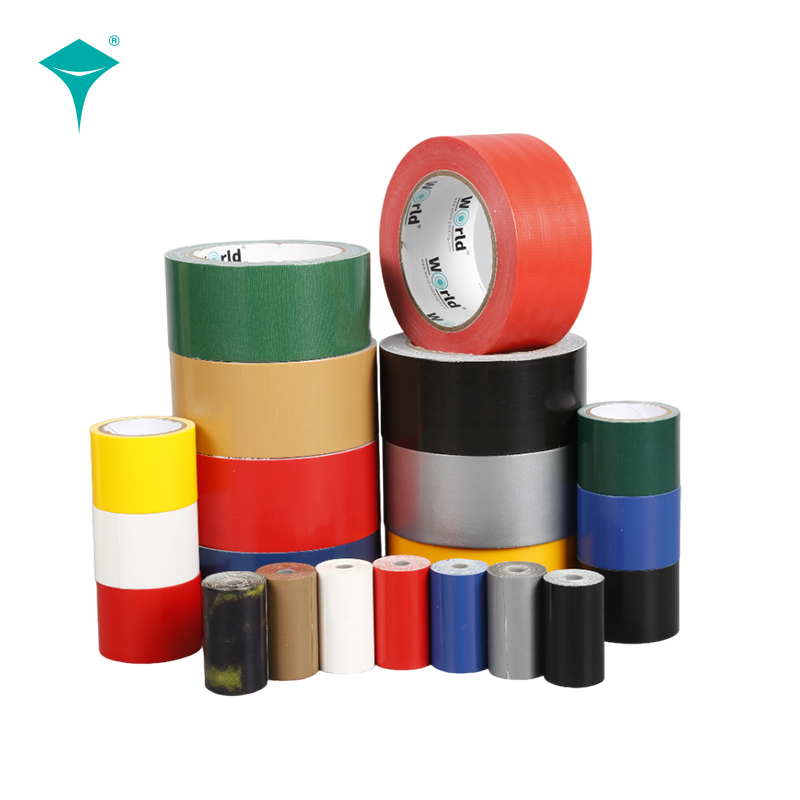
Cloth duct tape is widely used in packaging, construction, maintenance and industrial applications due to its flexibility, mechanical strength and convenient hand-tearability. Its performance depends on the backing construction, fabric mesh count, total thickness and adhesive formulation.
1. Main Components of Cloth Duct Tape
A typical PE-coated cloth duct tape consists of three main layers:
- PE coating: Provides a protective outer surface, water repellency and abrasion resistance, depending on the formulation and construction.
- Woven fabric: Usually made from cotton, polyester or blended yarns, providing reinforcement, tensile strength and flexibility.
- Pressure-sensitive adhesive: Provides bonding to the target surface. Rubber-based hot-melt adhesive is one common option, although other adhesive systems are also used.
2. How Do Mesh Count and Thickness Affect Performance?
Mesh count refers to the density of the woven fabric, commonly expressed as threads per inch. A lower mesh count generally indicates a more open weave, while a higher mesh count indicates a denser weave.
Higher mesh counts may provide more closely spaced reinforcement, but tensile strength and tearability also depend on yarn material, fabric construction and coating design. Mesh count alone cannot determine overall tape performance.
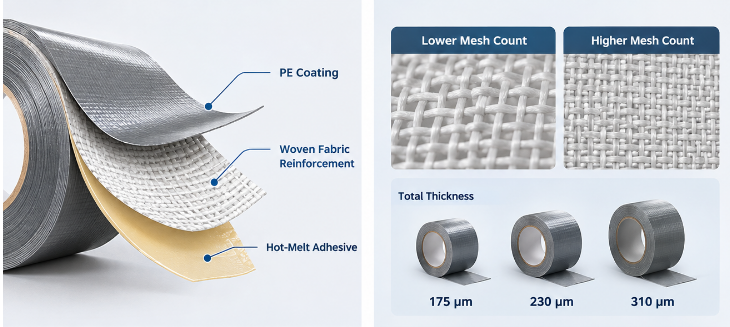
Total thickness, measured in micrometres (μm), includes the backing and adhesive layers. Thickness can affect handling, flexibility, protection and mechanical performance. However, a thicker tape does not necessarily provide stronger adhesion or higher tensile strength.
Therefore, mesh count and thickness should be evaluated together with tensile strength, peel adhesion, elongation and the intended application.
3. Common Applications
Cloth duct tape is used for:
- Packaging and bundling: Securing materials and temporary fixing.
- Construction and renovation: Fastening protective films and covering materials.
- Maintenance and repair: Wrapping, patching and general-purpose repairs.
- Surface protection: Temporary holding and selected protective applications.
The appropriate grade depends on the surface, required adhesion, environmental conditions and whether clean removal is necessary.
4. How to Choose the Right Duct Tape
When selecting cloth duct tape, consider the fabric type, mesh count, total thickness, adhesive performance and service conditions. Testing the finished product is essential to confirm suitability for the intended use.
For peel adhesion evaluation, refer to ASTM D3330/D3330M, Standard Test Method for Peel Adhesion of Pressure-Sensitive Tape.
References
- tesa® 4662 — Product Specifications
- tesa® 53799 — Product Specifications
- ASTM D3330/D3330M — Peel Adhesion Testing
Cloth duct tape performance is determined by the combined properties of its PE coating, woven fabric and adhesive system. Understanding mesh count and total thickness helps buyers compare products more effectively and select suitable solutions for their applications.
At World Packing, we focus on matching tape specifications to customers’ performance and application requirements. If any needs, feel free to contact us!